Why do we need to think about bitwise operations?
Understanding them is prereq to what we will see today and that will help you understand hardware overall.
You of course will not need every single thing we teach you in every single class.
Seeing topics once at least is the only way you can make an informed decision to study a topic deeper or not.
Seeing a topic in more detail than you will use all the time actually helps you build intuition, or deep understanding, of the topic overall, and help you remember what you need to remember
Bitwise operators review
&: and|: or^: xor~: not>>: shift right<<: shift left
Let’s review truth tables for and, or, and xor.
Table 4:AND
a | b | output |
|---|---|---|
0 | 0 | 0 |
0 | 1 | 0 |
1 | 0 | 0 |
1 | 1 | 1 |
Table 5:OR
a | b | output |
|---|---|---|
0 | 0 | 0 |
0 | 1 | 1 |
1 | 0 | 1 |
1 | 1 | 1 |
Table 6:XOR
a | b | output |
|---|---|---|
0 | 0 | 0 |
0 | 1 | 1 |
1 | 0 | 1 |
1 | 1 | 0 |
In order to implement more complex calculations, using gates, we can use these tables as building blocks compared to the required output.
There are more gate operations; you can see a simulation for 16 gates
Adding with gates
Let’s review adding binary numbers.
remember, binary is a place-based system like the decimal placed based system you are likely familiar with
Since binary is place-based adding with binary follows the same basic algorithm
work right to left (smallest to largest place values)
add the two values in a given place
carry to the next place if >=2
We first add the ones place and get a 1, then the two’s place and get a zero then the 4’s place and get 0 with a carried one.
In this case in the ones place we add 0 + 1 to get one, the two ones add to 0 with carry then 1 + 0 + 0 gives another 1.
let’s make a truth table for adding two bits.
Table 4:Add
a | b | a+b 2’s | a+b 1’s |
|---|---|---|---|
0 | 0 | 0 | 0 |
0 | 1 | 0 | 1 |
1 | 0 | 0 | 1 |
1 | 1 | 1 | 0 |
Now, what gate can we use to get the output 1’s place bit and what gate can we use to get the output 2’s place bit by comparing to the truth tables above.
It turns out the one’s place is an xor gate, and the two’s place is an and gate.
This makes up the half adder, try one out at this simulator.
So this lets us as two bits, but what about adding a number with more bits?
We can put multiple together, but there’s one more wrinkle: the carry.
That’s what makes a full adder different. It adds three single bits, or a carry and two bits and outputs the result as a sum bit and a carry bit.
Then we can link many of those together to get an 8 bit ripple adder.
Alternatively, we can “lookahead” with the carry bit, passing it forward multiple places all at once, as shown in this 4 bit carry lookahead adder.
Time vs space
Then we can link many of those together to get an 8 bit ripple adder.
Alternatively, we can “lookahead” with the carry bit, passing it forward multiple places all at once, as shown in this 4 bit carry lookahead adder.
Why do this?
Workign through this example also reinforces not only the facts of how the binary works so that you can understand how a computer works. Working with these abstractions to break down higher level operations into components like this (addition is a more complex operation than and or xor) help you see how this can be done.
Sometimes you have low level problems like resource constraints and bitwise operations can be useful.
We may not do this all the time, but when we need it, we need it.
for example, consider how to swap two values.
Assume we have two variables a and b intitialized like:
a =4
b =3
a,b
(4, 3)The sort of intro to programming way to swap them uses a third variable:
tmp = a
a= b
b = tmp
a,b
(3, 4)Let’s reset them
a =4
b =3
a,b
(4, 3)With bitwise operations we can swap them without a 3rd variable.
a = a^b
b = b^a
a = a^b
a,b
(3, 4)If we implement this with only 3 bits we have a 1,2,4 places.
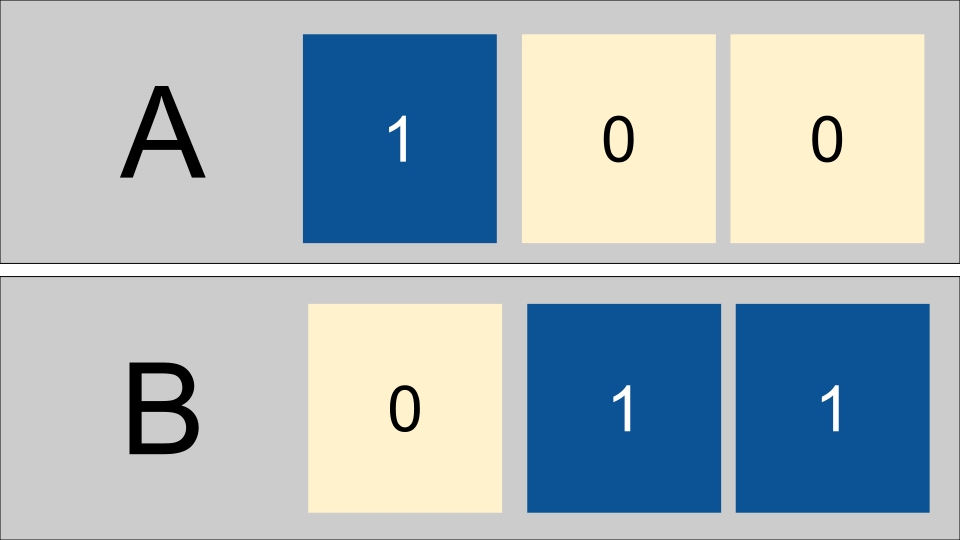
Then we xor each bit and store the result in the first register (our a variable)
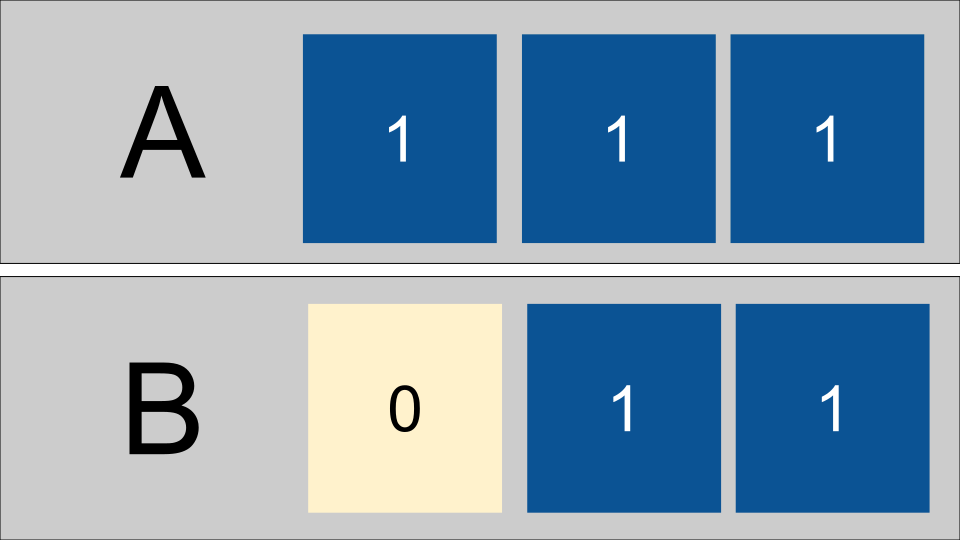
and next we xor again and store in b
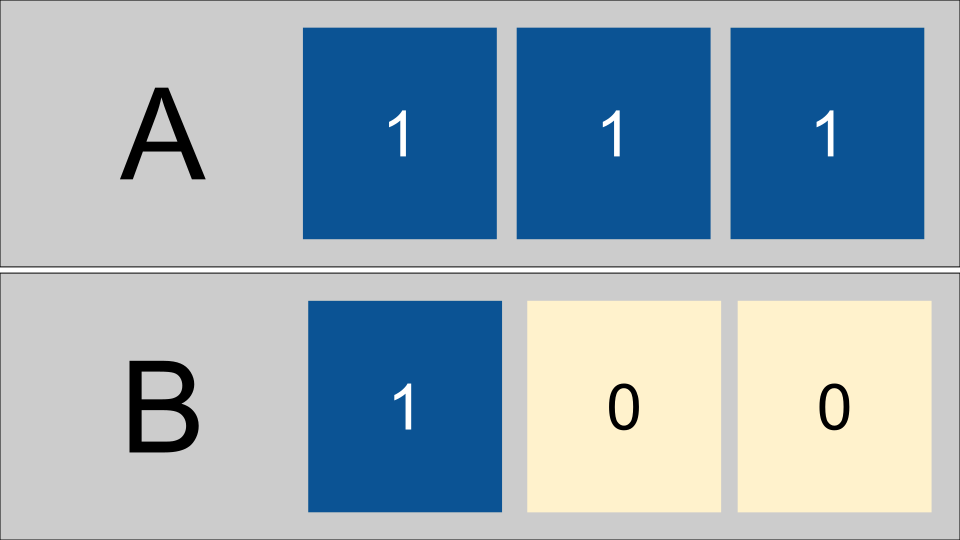
now the 4 has moved form A to B. If we xor one more time and store that in A,
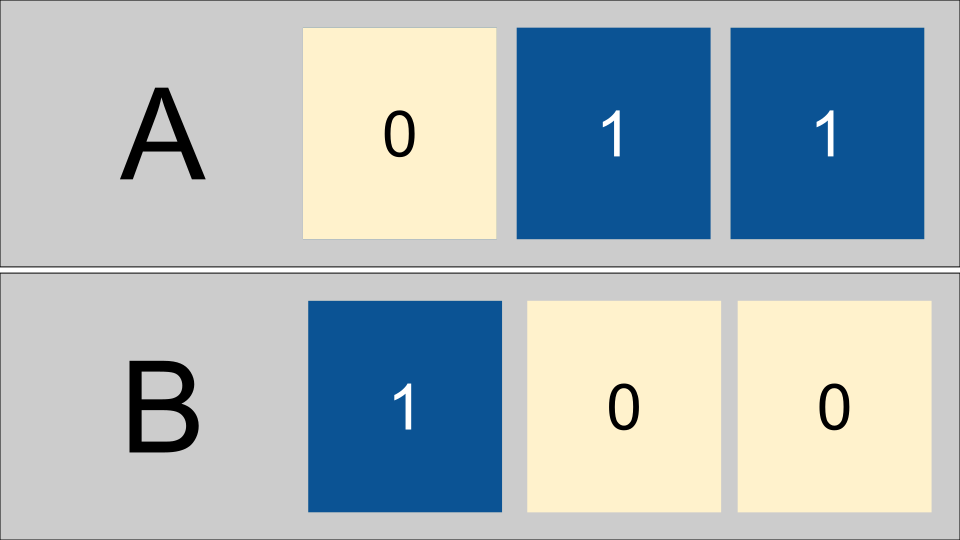
b =874
a = 87435
a = a^b
b = b^a
a = a^b
a,b
(874, 87435)Prepare for Next Class
watch this short video on an alternative adder
and this video on half adder with legos
Badges
Review the notes from today
While we saw many types of gates today, but we actually could get all of the operations needed using only NAND gates. Work out how to use NAND gates to implement
andandorin nandandor.mdFind what bitwise operation would complete each of these transformations (eg
1 << 3 = 4and4^4 = 0) that is replace the ? with a bitwise operator. For each show work to explain how you found it inbitwise.md:4 ? 3 = 32 11 ? 7 = 3 8 ? 2 = 2
Review the notes from today
While we saw many types of gates today, but we actually could get all of the operations needed using only NAND gates. Work out how to use NAND gates to implement a half adder and describe it in nandhalf.md
In addertypes.md compare ripple adders and lookahead adders.
1. Give a synopsis of each adder type
2. Compare them in terms of time (assume that each gate requires one unit of time)
3. Compare them in terms of space/cost by counting the total number of gates required.
Experiment with bitwise operators in python to derive 3 generic rules. Submit in
bitwise_expt.mdthat has code in cells and the output (eg like the notes). An example (that you cannot get credit for) is any number xor with itself is 0, ora^a =0.
hover over the explore ideas below and to make an issue if you want to work on that explore
explore: Learn about the alternative to these operations for quantum computing and compare and think about how we would need to change computing operations for quantum compared to the traditional gates we have been using
explore: for another application of bitwsie operations, design and describe an activity
Experience Report Evidence
Questions after class
How does a computer relate this process to decimals/negative numbers; basically things that aren’t just integers?
We saw floats last week, it’s also a place based even in floating point, so it still works.
Can a full adder be cascaded to add numbers larger than three bits?
A full adder adds, 3 1-bit numbers, and yess it can be cascaed to add more than one bit.
Does the alignment of logic gates whether series/parallel impact performance, as in other electrical components like resistors, transistors, etc, alignment does matter?
They need to be organized in the right way to execute the operation that you want.
Why did we learn temp varialbe swap?
That requires less contextual knowledge, like xor, in some way and less math. It also helps teach the concept of variables, which is the main thing we want people to learn in intro classes.
When will physical limitations of computing be reached?
This is a good explore topic.
is doing 64 bits just the same expanded?
Yes, we only looked at up to 8 bits because it is tractable to look at.